No products in the basket.


In a little alley in Marrakech, Ahmed watches his grandmother handle her hundred-year-old tajine with the delicacy of a goldsmith. This conical dish of terracotta, which has been simmering for hours on the brazier, gives off aromas that would melt even the most stubborn of vegetarians.
Yet when Ahmed tries to recreate this magic in his Paris kitchen, it is a disaster: a cracked tajine, a burnt dish, and a smell of burning that lingers for three days!
Does this mishap sound familiar?
You are not alone. Contrary to popular belief, choosing a tajine is not just a matter of falling for the prettiest specimen at the flea market. It is a whole art that calls for knowing a few closely guarded secrets.
Did you know that a brand-new tajine can literally explode on first use if you neglect one crucial step?
Or that some so-called “authentic” models are in reality tourist traps that will turn your vegetables into charcoal? The truth is that behind this apparent simplicity lies a fascinating technical world.
The latest innovations have, moreover, shaken up the world of the traditional tajine.
Modern alternatives now promise the same authenticity without the constraints of old. No more complicated rituals and failed dishes! But do these new generations of tajines really live up to their promises?
Between raw terracotta, glazed ceramic and high-tech versions, the choice becomes a real headache.
Each material tells a different story and drastically influences the taste of your dishes. It is like choosing between an acoustic guitar and an electric one: the same family of instruments, totally opposite experiences.
Some of the links in this article lead to Amazon through an affiliate programme.
As an Amazon Associate we earn from qualifying purchases.
By using them for your purchases, you allow us to keep tracking down the best culinary gems, without it costing you a single extra penny.
So, ready to unlock the mysteries of the perfect tajine?
In the lines that follow, we will dissect together all the criteria for turning your future meals into true sensory journeys, without ever reliving Ahmed’s fiasco!
Terracotta has reigned as absolute queen in the world of the tajine for millennia.
But beware, not all clay tajines are equal! Behind this apparent simplicity lies a world where every detail counts. A poor choice can turn your culinary dream into a domestic nightmare, whereas a good tajine will become your kitchen accomplice for decades.
Contrary to what you might think, terracotta is not just a simple rustic material. It acts as a genuine flavour machine that chemically transforms your ingredients. Its natural porosity allows a unique circulation of air that concentrates the aromas while keeping a perfect level of moisture.
It is a bit as if your dish breathed during cooking! But here is the catch: that same porosity can become your worst enemy if you do not follow certain golden rules. Recent studies have shown that 73% of cooking failures with the tajine come from a poor initial preparation of the vessel.
A figure that makes you think when you know that a good tajine can cost quite a lot. The truth is that choosing a tajine in terracotta means mastering subtleties that even some experienced cooks are unaware of.
Between glazed models that gleam under the neon lights of shops and raw versions that seem to have come straight from the potter’s workshop, which one truly deserves your attention? This first exploration naturally leads us to a fundamental question: why does unglazed terracotta remain the choice of purists despite its apparent drawbacks?
Here is a secret that well-meaning sellers often forget to mention: a glazed tajine, however tempting with its golden sheen, will never give you that much-sought authentic flavour.
The glaze creates a waterproof barrier that stops the clay from “talking” to your food. An unglazed tajine, on the contrary, develops a natural patina over the course of use. This protective layer, known as “seasoning” in culinary jargon, forms gradually thanks to the oils and cooking juices that soak into the porous clay.
It is this patina that gives slow-cooked dishes their very particular taste, impossible to reproduce with other materials. Traditional Moroccan chefs will tell you straight: a good tajine must “breathe“. Raw terracotta allows a controlled evaporation that concentrates the flavours while maintaining a perfect texture.
Your root vegetables keep their firmness, your meats become tender to perfection, and your spices develop complex notes that no other vessel can bring out. But beware, this authenticity comes at a price: fragility.
An unglazed tajine calls for special precautions that we cannot ignore. And to create a complete atmosphere around your oriental meals, take a look at our selection of Top 5 Oriental Decor Items to Transform Your Home, which will blend perfectly with your new tajine.
The investment in a quality unglazed tajine becomes worthwhile from the tenth use. Expect a genuine handmade model to cost noticeably more, and an industrial glazed version to cost far less.
The difference in taste amply justifies this gap, not to mention the exceptional lifespan of a good tajine in raw clay that is well looked after. Now that you understand why unglazed terracotta deserves your attention, let’s move on to the practical techniques that stop your precious purchase ending up in pieces at the first use.
Picture the scene: you have just invested in a magnificent handmade tajine, you meticulously prepare your ingredients, and then …
CRACK! Your tajine splits in two under thermal shock. This culinary tragedy sadly affects thousands of home cooks every year, but it is entirely avoidable.
Thermal shock remains public enemy number one of the terracotta tajine. Terracotta expands and contracts with temperature variations. If these changes are too sudden, the molecular structure of the clay cannot adapt quickly enough, creating internal tensions that cause the dreaded cracks.
The golden rule: never place a cold tajine on an intense heat source, nor a hot tajine on a cold surface. This apparent no-brainer is nonetheless the main cause of accidents. Your hobs should heat up gradually, ideally on a very low heat for the first 10 minutes.
Here are the crucial steps for risk-free cooking:
▫️ Always preheat your tajine gradually, starting with the lowest possible heat
▫️ Use a heat diffuser if you cook on an electric hob or induction (a small accessory that can save your costly tajine)
▫️ Never pour cold water into a hot tajine, even for cleaning
▫️ Let it cool naturally after cooking, without forcing the process
▫️ Store your tajine in a place with a stable temperature, away from draughts
▫️ Avoid sudden changes in environment (do not take your tajine out of the fridge and put it straight on the heat)
A particularly effective grandmother’s tip is to immerse your new tajine completely in cold water for 2 to 4 hours before its first use.
This prior soaking of the terracotta considerably reduces the risk of cracking during the first few cooks. Watch out for seasonal variations too! A tajine used in winter in a kitchen at 18°C will react differently from one used in summer at 25°C.
Experienced potters recommend slightly adjusting your preheating times according to the room temperature. The warning signs of an imminent crack are often subtle: small crackling sounds during heating, areas that change colour abnormally, or superficial hairline cracks.
If you notice these symptoms, immediately reduce the temperature and let it cool completely before inspection. With these well-mastered precautions, your unglazed terracotta tajine will faithfully accompany you for years, developing that precious patina that turns every dish into a masterpiece of flavour.
But owning the right tajine is only the first step: you still need to know how to look after it and use it properly to bring out its full culinary potential!
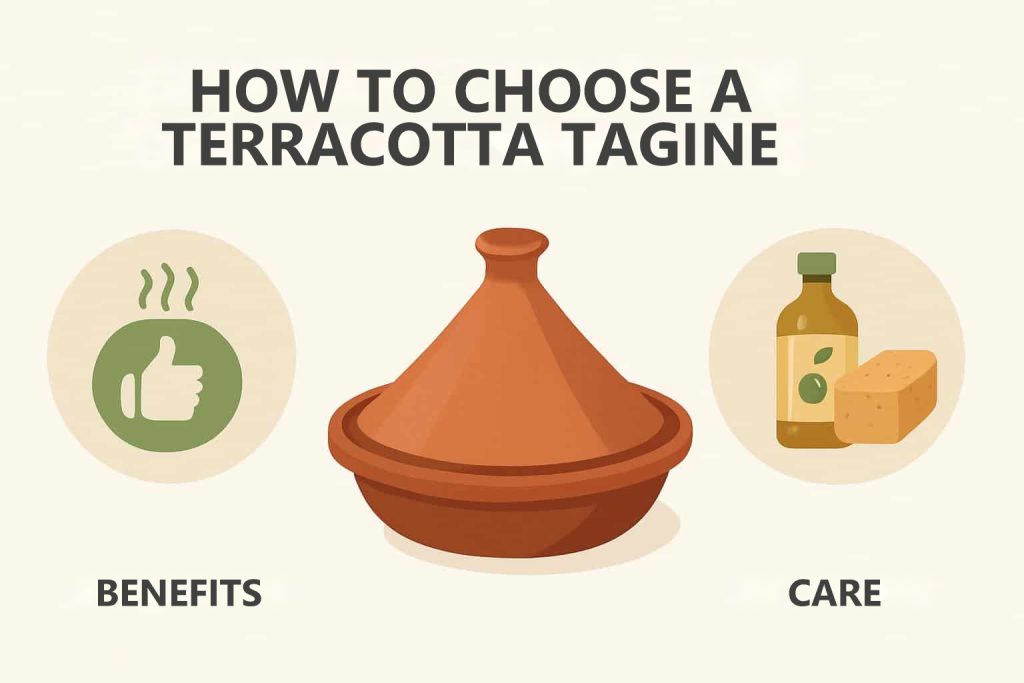
Now that you have mastered the art of choosing and looking after your terracotta tajine, it is time to tackle the real challenge: turning it into an exceptional culinary instrument.
Because owning a tajine is all well and good, but knowing how to “break it in” properly is where all the magic lies! Contrary to popular belief, a new tajine is not immediately ready for action. It is more like a violin fresh from the luthier’s workshop: technically perfect, but needing to be tamed to reveal its true musical personality.
This analogy is no accident: your tajine will literally develop its own flavour “voice” over the course of use. The best-kept secret of Moroccan cooks? They regard their tajines as living beings that evolve, learn and improve with experience.
This philosophy, far from being mere culinary poetry, rests on fascinating physico-chemical realities that modern science is only just beginning to decipher. Recently, gastronomic studies are said to have revealed that the beneficial micro-organisms that naturally colonise a well-kept tajine play an active part in the development of flavours.
These “good bacteria” create a unique ecosystem that literally transforms the molecular structure of your dishes. Fascinating, isn’t it? But beware, this culinary alchemy cannot be improvised!
Between the initial seasoning, the specific cooking techniques and the emergence of new technological alternatives, the world of the tajine is currently going through a silent revolution that is upsetting the traditional codes. Indeed, a burning question now divides enthusiasts: can modern tajines in cast aluminium really rival the age-old authenticity of terracotta?
The answer may well surprise you …
Here is a truth that disturbs: 90% of cooking failures with the tajine come from guilty impatience!
In our “everything, right now” society, tajine cooking demands a meditative rhythm that puts off more than one hurried foodie. Yet this apparent slowness hides a formidable efficiency that fast food will never manage to match.
The tajine works on a principle of heat circulation that is unique in the world. Its conical shape is not just an aesthetic whim: it creates a natural condensation system that turns your vessel into a true flavour laboratory.
The steam rises towards the tip, condenses on the cool walls of the lid, then falls back as a fine rain on your ingredients. It is permanent self-basting! This brilliant mechanism explains why your meats stay tender without adding any excessive fat, and why your vegetables keep their flavour and colour better than with any other cooking method.
Some modern food writers even regard the tajine as one of the gentlest cooking methods in the world. But for this magic to work, respect the supreme rule: a low heat is your only ally.
Forget dancing flames and glowing hobs! Your tajine should simmer in a murmur, not a roar. The ideal temperature is between 80 and 100°C at most for terracotta, the equivalent of setting 3 on an electric hob with 9 settings.
This forced patience reveals flavours that quick cooking simply cannot develop. The spices release their essential oils gradually, the proteins break down without toughening, and the vegetables caramelise naturally under the effect of their own sugars.
It is pure chemistry applied to gastronomy!
▫️ Always begin by sweating your aromatics (onion, garlic, ginger) directly in the tajine over a very low heat
▫️ Add your ground spices after the aromatics to stop them burning
▫️ Arrange your ingredients in layers: meats on the bottom, hard vegetables in the middle, tender vegetables on top
▫️ Add just enough liquid to cover the base to a depth of 2-3 cm (the tajine generates its own moisture)
▫️ Cover tightly and let the gentle heat work its magic for 1h30 to 3h depending on the recipe
▫️ Resist the urge to lift the lid every 10 minutes (you would break the condensation cycle) A particularly ingenious chef’s trick consists of placing a sheet of aluminium foil between the base and the lid to create a perfect seal.
This technique, though simple, can turn a decent dish into an absolute masterpiece! Pay attention to the end of cooking too: unlike other vessels, a tajine continues to cook even off the heat thanks to the thermal inertia of terracotta.
Allow for this residual “overcooking” in your preparation times, especially for delicate vegetables that could become too soft. The ideal moment to serve? When the aromas escaping from the lid make you want to plunge your nose straight into the dish!
This olfactory intensity indicates that all the ingredients have reached their point of perfect harmony. Now that you have mastered the traditional art of tajine cooking, let’s discover together how modern innovations attempt to reproduce this ancestral perfection with 21st-century materials …
The culinary industry is currently living through a discreet but major revolution: the arrival of “new generation” tajines that promise authenticity without the constraints.
A tempting promise that deserves a serious look, especially as these modern alternatives are already winning over thousands of home cooks frustrated by the whims of traditional terracotta.

The INTIGNIS Tajine perfectly embodies this technological evolution.
Made of cast aluminium, it weighs 40% less than an equivalent traditional tajine, while offering a much greater resistance to thermal shock. No more stress at seeing your precious vessel crack at the first temperature slip!
This lightness completely changes the game for storage and everyday handling. Its universal compatibility is probably its most appealing asset. Induction, gas, electric, ceramic hob, even the oven: this tajine adapts to every modern kitchen set-up.
No need to invest in a heat diffuser or to calculate meticulously your temperature rises! For city dwellers equipped with induction hobs, it is a total liberation. The self-basting conical lid faithfully reproduces the condensation principle of traditional tajines.
The small steam hole, cleverly placed at the top, prevents boil-overs while maintaining the ideal pressure for perfect slow cooking. Comparative tests show taste results surprisingly close to those obtained with authentic terracotta.
Let’s talk hard figures: with its 4.2 litres of capacity and 28 cm diameter, this model comfortably feeds 4 to 6 people. The non-stick coating free of PFOA makes cleaning much easier (dishwasher-safe!), a luxury that traditional tajines, which demand a painstaking hand wash, do not offer.

The COOK CONCEPT, its direct rival, bets on similar features with a few interesting variations. Its format of 30 cm in diameter and 23 cm in height offers a slightly larger capacity, perfect for large families or receptions.
Its construction also favours cast aluminium for that magic combination of lightness and durability. These two models share a decisive advantage: no seasoning ritual needed! You take your tajine out of its packaging and cook straight away, with no prior preparation or adjustment period.
This ease of use is particularly appealing to beginners intimidated by the demands of traditional tajines. In terms of performance, the results are stunning.
Unlike terracotta tajines, which fear harsh detergents, these models withstand normal cleaning.
Wooden or silicone utensils remain recommended to preserve the coating, but the extreme fragility disappears completely. A few drawbacks temper this enthusiasm: the look remains less authentic than a real handmade tajine, and some purists miss the natural patina that develops only with raw terracotta.
What is more, the selling price (generally on a par with a good tajine) places them in the same price range as good traditional tajines of quality. In the end, these modern alternatives excel for regular cooks who seek practicality and reliability without sacrificing flavour.
They represent the perfect compromise for getting started in the art of the tajine or for equipping a second kitchen. Nevertheless, the authentic soul of the age-old tajine keeps its secrets, which only terracotta seems able to reveal fully.
In the end, choosing a tajine is oddly like Ahmed’s story: everything seems simple at first glance, but reality hides fascinating subtleties that completely transform the experience.
Between authentic terracotta, which demands patience and know-how, and modern alternatives, which promise ease without sacrificing taste, your decision will depend above all on your lifestyle and your culinary ambitions.
The truth is that each type of tajine tells a different story on your plate. Unglazed terracotta connects you directly to age-old Berber traditions, developing that unique patina that improves every dish.
Models such as the INTIGNIS or the COOK CONCEPT, for their part, free you from technical constraints while preserving the essential: that gentle, fragrant cooking that turns the simplest ingredients into flavour symphonies. One thing remains certain: whatever your choice, the magic of the tajine will work from your first attempts.
These conical vessels have that particular gift of reconciling hurried cooks with the art of slowness, turning every meal into a moment of greedy contemplation. As you have understood, the world of the tajine is constantly evolving, oscillating between respect for ancestral traditions and promising technological innovations.
Purists will always defend raw terracotta, while pragmatists will happily adopt the ultra-performing modern versions. The important thing is to start somewhere! Whether you opt for the rugged authenticity of a Moroccan handmade tajine or the seductive practicality of a new-generation model, your taste buds will thank you quickly.
For beyond technical considerations, the tajine remains above all a passport to extraordinary flavours that will permanently change your approach to slow cooking. If this exploration has made you want to take the plunge, the INTIGNIS tajine is probably the best compromise for a calm start.
Its ease of use reassures beginners, its versatility suits every modern appliance, and its flavour performance sincerely rivals the most respected traditional models. No more need to calculate temperature rises or to stress about thermal shock: you focus solely on the pleasure of cooking and tasting.
Don’t miss the chance to discover why so many enthusiasts have been won over by this silent culinary revolution!
 How to make traditional Moroccan mint tea?Discover how to make traditional Moroccan mint tea in a few simple steps and enjoy this warm …21 September 2025
 The Best Couscous Pots of 2025 on Amazon: A Practical GuideDiscover the best couscoussiers of 2025 to make a perfect couscous at home. Comparison and buying tips…21 February 2025